
Is the Real Estate Market Crashing?
Quick Answer
No, the housing market isn't crashing. U.S. home prices rose 2.1% over the past year, and they've gone up every quarter since 2012. Growth is strongest in the Midwest and Northeast. Arizona prices grew less than 1%. In Scottsdale, homes are still selling, but buyers have more choices and more room to negotiate than they did a few years ago.
Spend ten minutes on YouTube or X, and someone will tell you the housing market is about to fall off a cliff. Big red arrows. Dramatic music. A thumbnail of a person looking shocked at a "For Sale" sign.
Some of those videos sound pretty convincing. I get it. If you're thinking about buying or selling, that kind of talk can keep you up at night.
So let's skip the drama and look at what the numbers actually say. I pulled the latest home price data for the whole country, ranked states and cities, and then zoomed in on what's happening here in Scottsdale, Cave Creek, Carefree, and North Phoenix.
Short version: the sky isn't falling. But the market is changing, and those changes matter for your plans.
Are home prices going up or down in 2026?
Home prices are going up, just more slowly than before. The Federal Housing Finance Agency (FHFA), a government agency that tracks home values, reports prices rose 2.1% nationwide from the second quarter of 2025 to the second quarter of 2026.
A few more facts help paint the picture:
• Prices rose 0.3% from the first quarter to the second quarter of 2026. That's a small step, which tells us the market is settling into a calmer pace.
• The yearly growth rate is a bit faster than it was at the start of 2026.
• Prices have climbed every single quarter since 2012. That's more than 50 quarters in a row.
That last point is worth sitting with for a second. Rates went up. Costs went up. Headlines got scary. And home prices still kept inching higher across most of the country.
A 2.1% increase isn't a boom. It's also not a crash. We’re seeing a market that’s settling down after several years of faster price growth.
Which states have the fastest-rising home prices?
Alaska, Vermont, and Hawaii lead the country for home price growth, followed by several Midwest and Northeast states. Most of the top ten share the same problem: there just aren't enough homes for sale to go around.
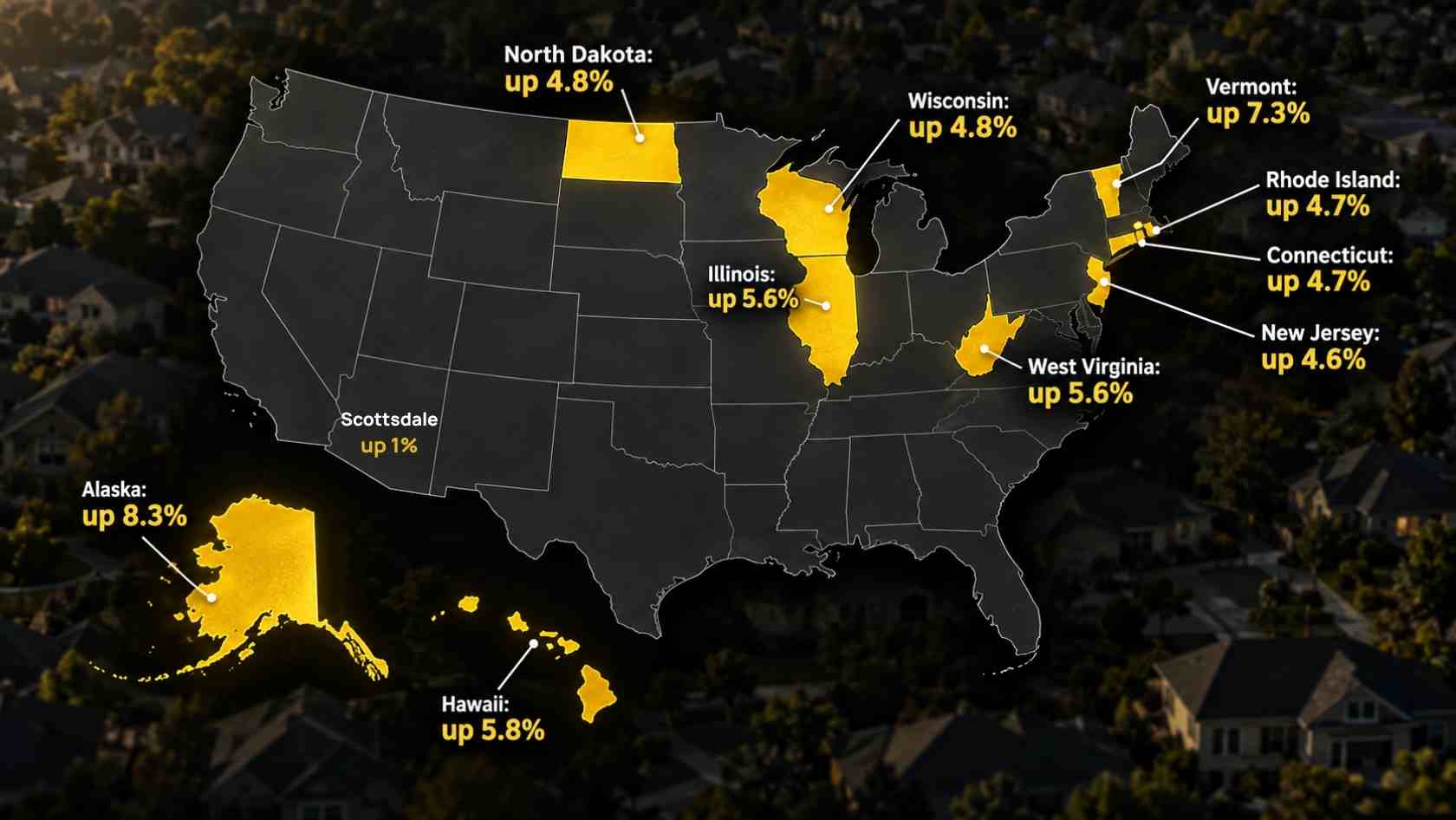
Here are the ten states with the biggest price gains over the past year, based on FHFA data mapped by the National Association of Home Builders (NAHB):
Top 10 States for Home Price Growth (Past Year)
| Rank | State | Yearly Price Change |
|---|---|---|
| 1 | Alaska | +8.3% |
| 2 | Vermont | +7.3% |
| 3 | Hawaii | +5.8% |
| 4 | Illinois | +5.6% |
| 5 | West Virginia | +5.6% |
| 6 | Wisconsin | +4.8% |
| 7 | North Dakota | +4.8% |
| 8 | Connecticut | +4.7% |
| 9 | Rhode Island | +4.7% |
| 10 | New Jersey | +4.6% |
Source: FHFA House Price Index, Q2 2026, as mapped by the National Association of Home Builders.
Notice a pattern? Places like Illinois, Wisconsin, Connecticut, and New Jersey didn't see the wild price jumps during the pandemic that the West and South did. Now they're catching up, and low inventory keeps pushing prices higher. (Inventory just means the number of homes for sale at any given time.) The map originally showed the top states. I added Scottsdale.
Which states have falling home prices?
Only four states saw home prices drop over the past year: New Mexico, Washington, Colorado, and California. Even in those states, the drops were small, all less than 1.5%.
States Where Home Prices Fell (Past Year)
| State | Yearly Price Change |
|---|---|
| New Mexico | -1.2% |
| Washington | -0.9% |
| Colorado | -0.5% |
| California | -0.2% |
Another group of states grew by less than 1% for the year. That list includes Arizona, along with Oregon, North Carolina, Texas, and Mississippi.
So Arizona prices didn't fall. They mostly held still. Many of these slower states are the same ones that saw prices shoot up during 2020 to 2022. After a sprint like that, a breather makes sense.
Which cities have the biggest home price gains?
Elgin, Illinois, tops the list with prices up 7.7% in a year. The rest of the top ten are mostly in the Northeast and Midwest, with a couple of surprises from the South.
Top 10 Cities for Home Price Gains (Past Year)
| Rank | Metro Area | Yearly Price Change |
|---|---|---|
| 1 | Elgin, IL | +7.7% |
| 2 | Allentown-Bethlehem-Easton, PA-NJ | +7.0% |
| 3 | Bridgeport-Stamford-Danbury, CT | +6.6% |
| 4 | Charleston-North Charleston, SC | +6.5% |
| 5 | El Paso, TX | +6.5% |
| 6 | Milwaukee-Waukesha, WI | +6.1% |
| 7 | Chicago-Naperville-Schaumburg, IL | +5.9% |
| 8 | New York-Jersey City-White Plains, NY-NJ | +5.6% |
| 9 | Newark, NJ | +5.5% |
| 10 | Greensboro-High Point, NC | +5.3% |
Source: FHFA House Price Index, Q2 2026, as mapped by the National Association of Home Builders.
Here's something interesting. El Paso is in Texas, and Texas as a whole barely grew. Charleston and Greensboro are doing well even though North Carolina and South Carolina didn't crack the state top ten. That's proof that one state can hold very different markets.
Which cities have falling home prices?
Everett, Washington, saw the steepest drop at 3.7%, and most of the cities with falling prices are in the West. That includes Tucson, the only Arizona metro on the list.
10 Cities Where Home Prices Fell the Most (Past Year)
| Rank | Metro Area | Yearly Price Change |
|---|---|---|
| 1 | Everett, WA | -3.7% |
| 2 | San Antonio-New Braunfels, TX | -3.0% |
| 3 | Bakersfield-Delano, CA | -2.6% |
| 4 | Seattle-Bellevue-Kent, WA | -2.4% |
| 5 | San Francisco-San Mateo-Redwood City, CA | -2.4% |
| 6 | Tucson, AZ | -2.2% |
| 7 | Albuquerque, NM | -1.7% |
| 8 | San Jose-Sunnyvale-Santa Clara, CA | -1.6% |
| 9 | Washington, DC-Maryland | -1.0% |
| 10 | Denver-Aurora-Centennial, CO | -1.0% |
Source: FHFA House Price Index, Q2 2026, as mapped by the National Association of Home Builders.
Why do short-term numbers look so scary sometimes?
Short-term price numbers swing a lot, so the year-over-year number is a more reliable guide. Take San Francisco. Its prices fell 9.1% compared to just the previous quarter. Over the full year, though, the drop was only 2.4%.
If someone only showed you that 9.1% number, you'd think the city was in free fall. That's exactly how a lot of scary headlines get made. One short window, one dramatic number, no context.
Why are some housing markets heating up while others cool off?
Two things explain most of it: affordability and housing supply. Expensive markets are cooling because fewer buyers can afford them. Markets with very few homes for sale keep climbing because buyers are competing for what's there.
How does affordability affect home prices?
When homes get too expensive for most buyers, demand slows and prices level off. With mortgage rates higher than a few years ago, monthly payments have jumped. Some buyers are waiting. Others are shopping in lower price ranges.
You see this most in pricey places like California and the Pacific Northwest. Prices there already soared over the past decade, so there's less room left to grow.
How does housing supply affect home prices?
When there aren't enough homes for sale, prices tend to hold steady or keep rising. That's what's going on in much of the Midwest and Northeast. Fewer new homes have been built there, and many owners are staying put.
It's basic supply and demand. Ten buyers and three houses? Prices go up. Three buyers and ten houses? Sellers start getting flexible.
Arizona sits in a different spot. Prices here rose fast during the pandemic as people moved in from other states. Wages and affordability haven't fully caught up, so prices are taking a breather while incomes close the gap.
What's happening with home prices in Scottsdale right now?
Scottsdale home prices are holding up well, but the pace has slowed and buyers have more leverage. Recent Arizona Regional MLS data shows a median sold price of about $1.15 million for single-family homes in September 2026, roughly .8% higher than a year earlier.
The median price is the price right in the middle. Half of homes sold for more, half sold for less. Here's a snapshot of where Scottsdale stood in mid-September 2026, based on single-family resale data from the Arizona Regional Multiple Listing Service (ARMLS):
Scottsdale Snapshot: Single-Family Homes (Sept. 2026)
| Measure | Number | What It Means |
|---|---|---|
| Median sold price | About $1,149,500 | Up roughly 8% from about $1,060,000 a year ago |
| Homes sold per month | About 298 | Slightly fewer than 321 a year ago |
| Months of supply | 3.3 | A fairly balanced market |
| Average days on market | About 92 days | Homes take a few months to sell |
| Sale-to-list price ratio | About 96% | Buyers are typically paying a bit under asking |
Source: Arizona Regional Multiple Listing Service (ARMLS) single-family resale data, mid-September 2026.
Months of supply is how long it would take to sell every home on the market if no new ones were listed. Under about 3 months usually favors sellers. Over about 6 favors buyers. Scottsdale is sitting near the middle.
Why does Scottsdale's median price jump around so much?
Scottsdale's median price can swing tens of thousands of dollars from month to month because the city has so many luxury homes. A few big sales in North Scottsdale can pull the number up one month, and a busy month for condos and townhomes can pull it down the next.
For example, the median dropped about $100,000 from August to September 2026. That doesn't mean homes lost value overnight. It mostly reflects which homes happened to sell. That's why I always tell clients to look at their own neighborhood and price range, not just the citywide headline number.
How does Scottsdale compare to the rest of the Valley?
Scottsdale is holding value better than many nearby areas. Arizona as a whole grew less than 1% over the past year. Tucson prices fell 2.2%. In the City of Phoenix, the September 2026 median sold price dipped about 3% from a year earlier, landing around $485,000.
In Cave Creek and Carefree, you'll often see longer selling times, especially for homes on larger lots or in the higher price ranges. Buyers there tend to be choosy, and they're willing to wait for the right fit.
Price Pulse Check: 3 questions to read your own market
The Price Pulse Check is a simple three-question test for figuring out whether your part of Scottsdale favors buyers or sellers. Big national headlines can't answer that. Your neighborhood's numbers can.
1. How long are homes sitting? If homes near you sell in under 30 days, sellers have the upper hand. If they're sitting 90 days or more, buyers can take their time and negotiate.
2. Are homes selling for full price? Look at the sale-to-list ratio. Above 98% means buyers are competing. Around 95% to 96% means there's room to ask for a better price or seller help with costs.
3. Are price cuts showing up? A lot of price reductions on your street or in your HOA community usually means sellers are priced too high and buyers are pushing back.
Run those three questions, and you'll know more about your market than any YouTube video can tell you.
Should I buy a home in Scottsdale right now?
If you're ready financially and plan to stay a while, this can be a solid time to buy in Scottsdale. With about 3.3 months of supply and homes selling for around 96% of asking price, buyers have more room to negotiate than they've had in years.
That doesn't mean every home is a bargain. Well-priced homes in popular areas still move quickly. But in many price ranges, you can:
• Take time to compare a few homes instead of making snap decisions
• Ask for repairs or seller credits (money the seller puts toward your closing costs or rate)
• Write an offer below asking price when a home has been sitting a while
And with fall bringing cooler weather and seasonal residents back to the Valley, now is a comfortable time to tour homes before winter traffic picks up.
Should I sell my Scottsdale home in 2026?
Yes, if your home is priced right from the start and shows well. Scottsdale prices are still higher than a year ago, so most owners have built up solid equity. (Equity is the part of your home you truly own: its value minus what you still owe.)
The sellers doing best right now tend to:
• Price for today's market, not what a neighbor got two years ago
• Handle repairs early, especially AC units, roofs, and pool equipment
• Show off outdoor living, like shaded patios, mountain views, and easy-care desert landscaping
• Stay flexible on credits or closing dates when a serious buyer shows up
A home priced 5% too high can sit for months. A home priced right often gets more attention in its first two weeks than it will in the next two months.
By the Numbers: 2026 Home Price Snapshot
• 2.1%: U.S. home price growth over the past year (FHFA, Q2 2026)
• 0.3%: U.S. home price growth from Q1 to Q2 2026
• 50+: Straight quarters of rising U.S. home prices since 2012
• 8.3%: Alaska's yearly price growth, the highest of any state
• Under 1%: Arizona's yearly price growth
• -2.2%: Tucson's yearly price change
• About $1.15 million: Scottsdale median single-family sold price, September 2026
• About .8%: Scottsdale's year-over-year median price increase
• 3.3 months: Scottsdale months of supply
• 96%: Typical Scottsdale sale-to-list price ratio
The Bottom Line
The housing market isn't crashing. It's cooling in some places, heating up in others, and holding fairly steady here in Scottsdale. Prices are still higher than a year ago, but buyers finally have some breathing room.
Buying or selling a home is a big deal, and all the noise online doesn't make it easier. Every home has its own story. Your street, your HOA, the condition of your house, and the type of home you own all shape what it's worth today.
If you'd like to know what's happening on your street, I'm happy to pull the numbers and talk it through with you. No pressure, no scary thumbnails. Just real data and a friendly local perspective.
Frequently Asked Questions
Is the housing market going to crash in 2026? The data doesn't point to a crash. U.S. home prices rose 2.1% over the past year and have increased every quarter since 2012. Some markets are cooling, but most are still growing slowly.
Are home prices dropping in Arizona? Arizona prices grew less than 1% over the past year, so they mostly held steady. Tucson saw a 2.2% drop, while Scottsdale's median single-family price was about .8% higher in September 2026 than a year earlier.
What is the median home price in Scottsdale? The median sold price for Scottsdale single-family homes was about $1,149,500 in September 2026, based on Arizona Regional MLS data. It can swing month to month because of the city's many luxury sales.
Is Scottsdale a buyer's market or a seller's market? Scottsdale is fairly balanced right now, with about 3.3 months of supply. Homes typically sell for around 96% of asking price, which gives buyers some room to negotiate.
Why are home prices rising faster in the Midwest and Northeast? Those regions have a shortage of homes for sale. When buyers outnumber available homes, prices tend to keep climbing.
Judy Orr, Realtor® HomeSmart | ADRE #SA689963000 Serving Scottsdale, Cave Creek, Carefree, and North Phoenix | 480-906-1500 | ✉️ judyorr@judyorr.com
Curious what your home is worth? Fill out the free home evaluation form.
Looking to buy? Fill out the Automated Home Buyer's Form.
Enjoy this blog post? Click here to subscribe for updates
Leave A Comment