

Getting Under Contract Used to Feel Like the Finish Line. Not Anymore

Something genuinely interesting is happening in the housing market right now, and if you're thinking about selling your home, this is exactly the kind of thing you need to understand before you put up that for sale sign.
Back in the not-so-distant past, getting a buyer to sign a purchase agreement felt like you had basically won. Pop the champagne, start packing boxes, call the moving company. The hard part was over. But that's just not the reality anymore, and the numbers tell a pretty striking story about how much things have changed.
In December alone, roughly 40,000 home purchase agreements across the United States were canceled before ever making it to the closing table. That works out to about 16.3% of all homes that went under contract that month. To put that in plain terms, more than one out of every six deals fell apart. According to Redfin, which has been tracking this kind of data since 2017, that December cancellation rate is the highest they have ever recorded. Not just a little higher than usual. The highest ever. That's worth paying attention to.
And it's not like this came out of nowhere. The rate was already sitting at 14.9% back in December of the previous year, so this has been building for a while. The trend is moving in one direction, and sellers who aren't aware of it are going to be caught off guard.
So Why Are Buyers Walking Away?
Here's the thing about the current market that makes it so different from what we saw just a few years ago. Buyers have actual choices now. Inventory has been climbing in a lot of markets around the country, which means someone shopping for a home today isn't necessarily in a desperate situation where they have to grab whatever becomes available or risk losing out forever.
Chen Zhao, who leads economics research at Redfin, put it really well. When sellers outnumber buyers by a record margin, the people who are out there shopping can afford to be picky. If they get into a contract and then start having second thoughts, whether because the inspection turned up something sketchy, the mortgage payment feels like too much, or they spotted another home they like better down the street, they have real leverage to just walk away.

That inspection contingency piece is actually really important to understand. A lot of buyers will technically cite a structural issue or some maintenance problem discovered during inspection as their official reason for backing out. But sometimes that's not really the whole story. The inspection gives them a clean exit if they've already been quietly reconsidering whether they can actually afford the monthly payments. So the stated reason and the real reason don't always match up perfectly.
The good news, at least if you're a buyer or a seller hoping the market finds its footing, is that mortgage rates have come down a bit recently, and price growth is cooling off. Redfin's economists are actually fairly optimistic that affordability will gradually get better heading into 2026 as wages start outpacing housing costs. That's not a guarantee, but it's a reason to stay engaged rather than give up on the market entirely.
The Cities Where Deals Are Falling Apart Most Often
Not every city is experiencing this the same way. Geography matters a lot here, and some markets are seeing cancellation rates that are genuinely eye-opening.
Atlanta is currently sitting at the top of the list in the worst possible way, with 22.5% of pending home sales falling through in December. That's up from 19.6% just the month before. To make sense of that number, think about it this way: in Atlanta right now, sellers outnumber buyers by more than 80%. That's an enormous imbalance, and it creates exactly the kind of environment where buyers feel comfortable walking away from deals that don't feel perfect.
Jacksonville and San Antonio both came in at 20.6%, followed closely by Cleveland at 20.2% and Tampa at 19.4%. These are all markets where inventory has grown significantly, and buyers have regained a lot of the power they lost during the pandemic-era frenzy.
On the complete opposite end of the spectrum, some markets are barely registering cancellation activity at all. Nassau County in New York had a rate of just 3.8% in December. San Francisco came in at 4.2%. San Jose was at 8.9%, and New York City overall sat at 10.5%. These are markets where demand stays consistently strong, and buyers still feel enough urgency that they're less likely to get cold feet after signing.
As mentioned, Florida has some high contract cancellation rates. Jacksonville and Tampa are one of the tops, as mentioned above, followed by Orlando at 19.3% in 2025, which is actually lower than 19.5% in 2024. Miami took a jump to 17.2% in 2025 from 14.2% in 2024.
Las Vegas is high at 19%, an increase from 15.5% in 2024.
The Bay Area Rollercoaster

What's happening in California's Bay Area is genuinely fascinating because it illustrates just how dramatically a market can shift in a short period of time. San Jose saw the biggest year-over-year jump in cancellations among all the major metros analyzed, climbing 6.8 percentage points to reach 8.9%. Oakland jumped 6.3 points to 11.3%. Sacramento went up 4.7 points to hit 17.9%.
For context, the Bay Area went through a major cooldown in 2022 after the pandemic boom, then somehow became one of the hottest markets in the entire country toward the end of 2025, and now it's settling into something more balanced. That's a wild ride for anyone trying to buy or sell there.
Alison Williams, a real estate agent working in Sacramento, described what she's seeing on the ground really clearly. Buyers have options, and they know it. They're not shy about negotiating hard, and if a seller hasn't taken care of obvious maintenance issues or is pricing their home based on wishful thinking rather than market reality, buyers are comfortable walking away. Cost is the central issue driving everything right now.
Meanwhile, some markets actually saw cancellation rates drop compared to the previous year. Detroit fell by 8 percentage points, which is the biggest improvement in the data. Warren, Michigan was down 2.8 points. Pittsburgh dropped 2.3 points. Those markets seem to be finding more stability, which is good news for sellers operating there.
Where Does Phoenix Sit?

The Phoenix area, including suburbs such as Scottsdale real estate, Carefree, Cave Creek, Mesa, Chandler, Gilbert, Fountain Hills, etc., is sitting on the high side. December 2025 showed 18.8% of canceled contracts compared to December 2024's 18.1%. Not a huge difference.
I see real sticker shock from people coming here from the Midwest, although many midwestern states are showing double-digit contract cancellations. The Chicago area and suburbs, where I hail from originally, is showing a 17.2% cancellation rate in 2025, compared to 16.2% in 2024.
True story: One of my clients put an offer on a Scottsdale condo for sale back in October 2025. It was accepted at a small discount on price by the seller. The home inspection showed that the AC/heat pump was at the end of its lifespan, actually over the expected lifespan. It was still working, but my buyer didn't want to deal with a replacement that would come sooner rather than later. He asked for the seller to replace the unit, and would have most likely accepted a financial offer. But the seller wouldn't budge, so my buyer walked.
Soon after, the same floor plan came up in the same complex, and we were the first to see it. My buyer made a full-price offer, and he did so because it was priced low to begin with. Almost $50,000 lower! It needed a cleaning, but otherwise it was a great deal, and it had a newer AC/heat pump than the other condo. It all worked out perfectly for my buyer, who saved $42,500.
However, that first seller had to take a couple of price reductions to the point where his first price change was $10,000 less than his original list price (and more than $3,000 less than the accepted offer he had with my buyer). The second price drop was $30,000 lower than his original asking price, and it is finally under contract after 164 days on the market. We won't know what it actually sells for until it's closed.
This seller would have been better off if he had replaced the AC/heat pump when my buyer asked (based on estimates received, the average price would have been around $10,000). He ended up losing at least $30,000 by turning my buyer's request down (he could have purchased almost 3 AC units). And if he had offered my buyer a fair amount for replacement (not even the entire cost), he would have been closed by now with a much higher net than his current contract.
What This Actually Means If You're Selling

Here's where this gets really practical. If you're a seller or you're thinking about becoming one, the mental model you need to operate with has fundamentally changed from what it was even two or three years ago.
Getting under contract used to be the part where you exhaled. In today's environment, it's really more like the halfway point of a longer process. You still have the inspection to get through, and buyers are going to look at every finding with fresh eyes, especially if they're already a little uncertain about the decision. You still have the financing contingency period, where a buyer's mortgage situation could shift. And in markets with plenty of inventory, your buyer knows that if they walk, they have other options waiting.
The homes that actually make it from contract to closing in this environment tend to share a few things in common. They're priced honestly and competitively against what else is available nearby, not based on what the seller hoped to get six months ago. They're marketed in a way that attracts buyers who are genuinely serious rather than just curious. And the sellers behind those deals tend to stay calm and strategic when bumps come up because they understand what's happening in the market rather than being blindsided by it.
That last piece, the staying calm part, is honestly where a lot of deals quietly fall apart or quietly get saved. When sellers don't really understand why their buyer is suddenly asking for repairs or pushing back on price after the inspection, it's easy to get defensive or emotional. Which is obviously what happened with the seller in my true story above. But when sellers have context, when they know their agent is actively marketing the home, when they can see how their listing compares to others in the market, and when they understand that some negotiation after inspection is just normal right now, they're in a much better position to stay the course and get to closing.
The market has genuinely shifted power back toward buyers in a significant way. That doesn't mean selling is impossible, not even close. It just means the sellers who succeed are going to be the ones who go in with clear eyes about what's happening and a strategy built for the market as it actually exists today, not as it existed a few years ago.
Is the Housing Market Going to Collapse?
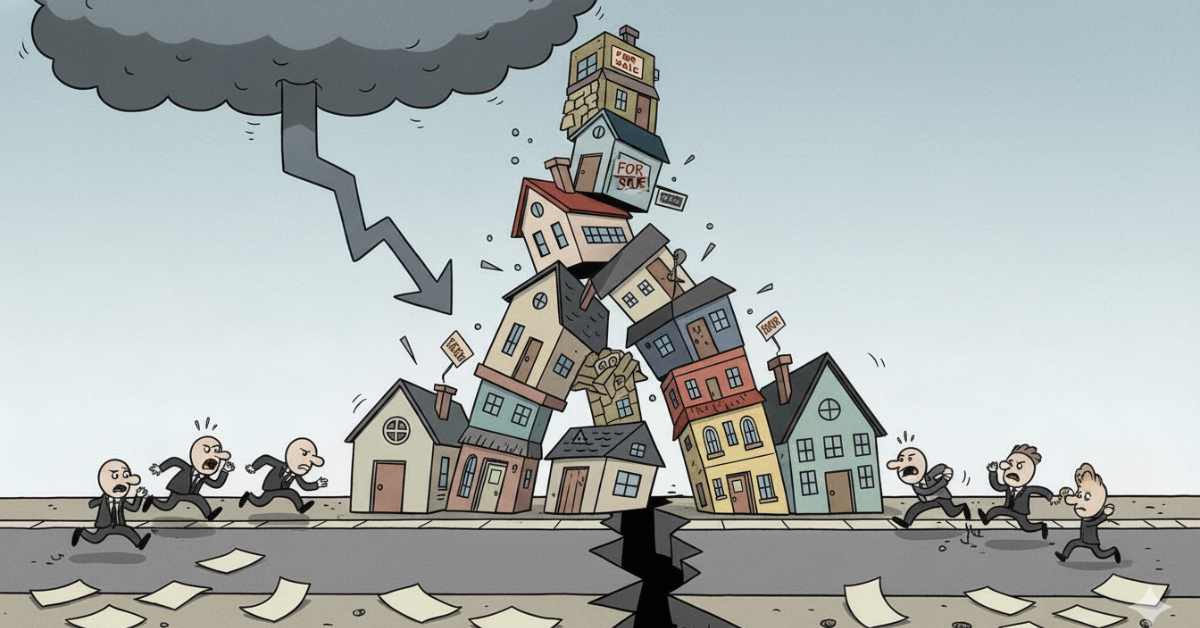
Headlines about record numbers of canceled home purchase contracts can sound alarming, but they don’t necessarily signal that the housing market is headed for a collapse. In reality, they often reflect a market that’s simply returning to balance after several years that strongly favored sellers.
During the pandemic housing boom, buyers had very little negotiating power. Homes received multiple offers within days, contingencies, including home inspections and appraisals, were waived, and many buyers felt pressured to move forward even when they had doubts. Canceling a contract was rare because there were few alternatives.
Today’s market looks different. Inventory has increased, which means buyers have more homes to choose from and more time to make decisions. If a home inspection reveals problems, the appraisal comes in low, or the seller refuses to negotiate on repairs or price, buyers are more willing to walk away and pursue another property.
In other words, higher cancellation rates don’t necessarily mean buyers are disappearing or that prices are about to crash. Instead, they often signal that buyers now have options—and are using them.
For sellers, the lesson isn’t panic - it’s preparation. Homes that are priced correctly, well-presented, and marketed effectively are still selling. But sellers may need to be more flexible with negotiations, repairs, and pricing than they were a few years ago.
A shifting market doesn’t mean a failing one. It simply means the rules of the game have changed, and both buyers and sellers are adjusting accordingly.
If you’re planning to sell your home this year, make sure you have the right strategy behind you. With more than four decades of experience, Judy Orr has developed a proven marketing system designed to showcase your home, attract serious buyers, and create the kind of competition that helps drive the highest possible price. If you want your home sold quickly—and sold well—call Judy Orr at 480-906-1500 to get started.
Posted by Judy Orr onEnjoy this blog post? Click here to subscribe for updates
Leave A Comment